
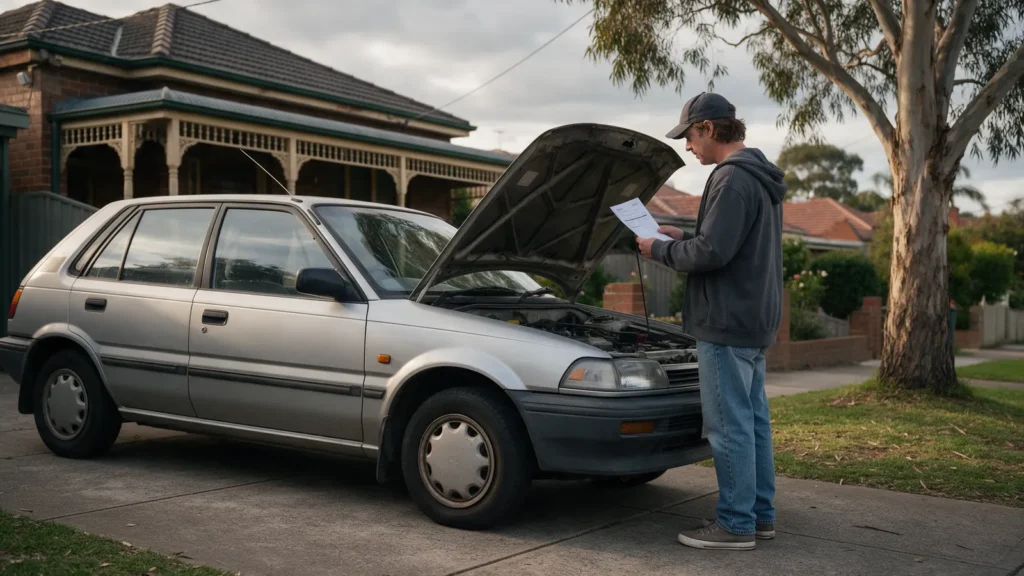
Repair your car when the quote is less than the value the repair adds, the rest of the car is sound, and it will stay safe and affordable to run. Scrap it when the repair costs more than the car will be worth once fixed, when other big faults are queued up behind this one, or when the car no longer protects you the way a newer one would.
That is the whole decision in two lines. The hard part is putting honest numbers against each side. This guide walks through the quote, the car’s value both ways, the cost of keeping it registered and roadworthy, safety, and running costs. Work through each step with your own figures and the answer usually becomes obvious.
The Three Numbers That Decide Repair or Scrap
Every repair or scrap decision comes down to three figures. You need all three before you can compare anything.
- The full repair cost. The written quote, plus anything the mechanic expects to find once the job is opened up.
- The value gap. What the car would be worth fixed, minus what it is worth today in its broken state.
- The next 12 months. Registration, insurance, servicing, tyres and any other repairs you already know are coming.
The basic test is simple. If the repair costs more than the value gap, you are paying more than the fix is worth. If the repair costs less than the value gap, and the next 12 months look manageable, repairing is usually the better call.
Use this fill-in table with your own numbers:
| Line | Your figure |
|---|---|
| A. Value of the car once repaired (private sale or trade-in) | |
| B. Value of the car as it sits now (wrecker or as-is sale) | |
| C. Value gap (A minus B) | |
| D. Written repair quote, including likely extras | |
| E. Known costs over the next 12 months | |
| Repair makes financial sense when D is clearly below C, and E is affordable |
Step 1: Get a Repair Quote You Can Actually Trust
A vague phone estimate is not a number you can decide on. Consumer Affairs Victoria advises drivers to ask for a written estimate before any work starts. It should list the work to be done, the parts to be supplied, the labour cost and the expected completion time.
Big mechanical jobs grow once the car is opened. A blown head gasket can reveal a warped cylinder head. A failed gearbox can turn out to need a torque converter or clutch as well. Ask the mechanic directly: “If you find more damage, what is the most likely extra cost?” Then add that to line D.
Three more checks protect you here:
- Ask to be called before any extra work. Make it clear nothing outside the quote gets done without your approval.
- Get a second opinion on any major quote. Engine and transmission faults can be hard to pin down, and a second quote confirms both the diagnosis and the price.
- Watch the storage clock. If your car is already sitting at a workshop, Consumer Affairs Victoria notes the mechanic can keep it until the bill is paid (a “mechanic’s lien”) and in some cases charge storage fees. Decide quickly so storage costs do not eat into either option.
Step 2: Work Out What the Car Is Worth, Broken and Fixed
Line A is what the car would sell for in good running order. Look at comparable listings for the same model, year, kilometres and condition. Be honest about dents, worn interiors and service history, because buyers will be.
Line B is what the car is worth today, as it sits. For a car with a major mechanical failure, this is usually the price a wrecker will quote. That figure depends on the make and model, the demand for its parts, its weight in steel and the current scrap metal market. Our guide to what wreckers pay for cars in Melbourne explains the price factors in detail. Get a real quote rather than guessing, because a car with a dead engine can still have a valuable gearbox, panels or interior.
A narrow value gap is a strong scrap signal: if the car is worth only a little more running than broken, a large repair bill can never pay for itself.
If you still owe money on the car, check the finance position before you choose either path. A car with finance attached cannot be cleanly sold until the debt is cleared.
Step 3: Add the Cost of Keeping It on the Road
This is the line most people skip, and it changes a lot of decisions. A repaired car still has to be registered, insured and roadworthy.
Registration. The Victorian Government stated in April 2026 that light vehicle registration costs up to $930.70 every year for every car. If your registration is due soon after the repair, that is money you pay on top of the repair bill. If you scrap the car instead, you can cancel the registration and claim a refund of the unused time.
Roadworthy certificate. VicRoads says a Certificate of Roadworthiness is required whenever a vehicle is sold, re-registered, or to clear some defect notices. That matters in two common situations:
- If the car’s registration has lapsed while it sat broken, you will need a roadworthy to re-register it after the repair.
- If you plan to repair it and then sell it registered, you will need a roadworthy for the sale.
The Victorian Department of Transport and Planning notes that the cost of a roadworthy varies with the age, type and condition of the vehicle, and recommends getting a quote before the inspection. Any items the tester fails, such as worn tyres, brakes, suspension or rust, become extra repair costs. Add a realistic allowance to line E.
A roadworthy is also not a health check. VicRoads states it shows a car is safe enough for the road at the time of inspection, not that it is mechanically reliable. A car that has just passed can still need a gearbox next year.
Moving an unregistered car. If the registration has lapsed, you cannot simply drive the car to a workshop or tester. Consumer Affairs Victoria explains that an Unregistered Vehicle Permit usually only allows driving to a home or licensed tester at set times. Otherwise it needs to be towed or trailered. For the full picture on selling without a certificate, read our guide to selling a car without a roadworthy in Victoria.
Step 4: Ask Whether the Car Is Still Safe Enough
Money is only half the decision. Older cars give occupants less protection in a crash, and that cost does not show up on a quote.
In June 2022, the Transport Accident Commission (TAC) reported that around two thirds of drivers and passengers killed on Victorian roads in 2021 were in vehicles more than 10 years old. The TAC links this to missing safety features such as autonomous emergency braking, electronic stability control and curtain airbags.
Safer does not have to mean expensive. In November 2025, the TAC, the Department of Transport and Planning and the Monash University Accident Research Centre released updated Used Car Safety Ratings. They found that all but one of the “safer pick” vehicles can be bought second-hand for less than $25,000, and more than half for $10,000 or less.
So the safety question to ask is direct. If the car you are about to spend heavily on lacks stability control, curtain airbags or emergency braking, compare it with a rated replacement on the How Safe Is Your Car website before you approve the repair. Rust in the floor, sills or suspension mounts is another safety red flag. It is often expensive to fix properly and can fail a roadworthy on its own.
Step 5: Compare Running Costs Honestly, Both Ways
Scrapping is not automatically the cheaper path. A replacement car has its own costs, and a paid-off older car can be cheap to keep once the big fault is fixed.
The RACQ’s 2025 running costs report put the average cost of a new light passenger car at $11,748.92 a year. That figure assumes a five-year car loan and 15,000 km a year, and covers loan repayments, registration, insurance, fuel, servicing and tyres. Most of it is loan repayments. A paid-off car avoids that cost entirely.
That gives you a fair comparison:
- Repair wins when the car is otherwise reliable, owned outright, and the repair resets it for several years of use.
- Scrap wins when the repair is one of several large jobs due soon, fuel use is high, parts are hard to find, or the car has started breaking down often.
A good rule for older cars: count how many workshop visits for unplanned faults you have had in the past year. One major fault on a well-kept car is a repair case. A third major fault in a year is a pattern, and the next one is already on its way.
Common Breakdowns: Repair or Scrap?
The fault itself tells you a lot about the likely outcome. These are guidelines, not rules, because the car’s age and value still decide the final answer.
Blown head gasket. Often repairable if caught early and the engine was not driven hot for long. If the engine overheated badly, ask whether the head is warped or cracked and whether a compression or leak-down test has been done. Severe overheating on an older car leans towards scrap.
Failed automatic gearbox. Usually one of the most expensive repairs a car can need. Ask for the cost of a reconditioned or used replacement unit, not just a rebuild. On an older, lower-value car, the gearbox alone can exceed the value gap.
Seized or failed engine. A replacement engine can make sense on a car that is otherwise in good order and in demand. On a high-kilometre car with tired suspension, rust or worn interior, the money rarely comes back.
Serious rust or structural damage. Leans strongly towards scrap. It is labour-heavy to repair properly and directly affects safety and roadworthiness.
Quick Decision Checklist
| Repair it if… | Scrap it if… |
|---|---|
| The quote is well below the value gap | The quote is close to or above the value gap |
| The rest of the car is sound and serviced | Other major faults are already showing |
| The car has modern safety features | It lacks basic safety features you would want in a replacement |
| Registration and roadworthy costs are low or already paid | Rego has lapsed and a roadworthy would need more work |
| You own it outright and it suits your needs | You were already planning to replace it |
If You Decide to Scrap: What Happens Next
Once you choose to scrap, a few steps protect you and get money back where you can.
Arrange collection. A broken-down car usually cannot be driven, so it needs to be collected. We collect broken-down, damaged and unregistered vehicles from homes, businesses, holding yards and roadside breakdowns through our car removal service. We do not attend accident scenes, because accident towing in Melbourne is licensed and allocated through a roster.
Get paid the legal way. Victoria bans cash payments for vehicles bought as scrap. Consumer Affairs Victoria requires payment by electronic funds transfer or non-transferable cheque, and dealers must record the seller’s identity and the vehicle’s details.
Notify VicRoads. VicRoads requires the seller to submit a notice of disposal within 14 days, which can be done online through myVicRoads.
Cancel the registration. If the car is still registered, you can cancel it and claim a refund for the unused time. VicRoads accepts a wrecker’s receipt as evidence, and deducts a processing fee plus 10 per cent of the TAC charge. Number plates no longer need to be returned.
Know where the car goes. EPA Victoria’s guideline for auto recyclers covers removing fluids, batteries and other hazards before a car is crushed, so oil and coolant do not end up in soil or stormwater.
Have your identification and proof of ownership ready on pickup day.
Frequently Asked Questions
Is it worth fixing a car that is worth less than the repair?
Usually not. If the repair costs more than the difference between the car’s repaired value and its current value, you lose money on the fix. The exception is a car you own outright, that is otherwise sound and safe, and that would cost more to replace than to repair.
Can I scrap a car that is not registered or has no roadworthy?
Yes. Consumer Affairs Victoria states that a car which is unregistered, or whose registration has been cancelled, can be sold without a roadworthy certificate. You still need to prove ownership and identity, and a scrap buyer must pay by EFT or non-transferable cheque.
Do I get money back on my rego if I scrap my car?
You can. VicRoads lets you cancel the registration and refunds the unused time, minus a processing fee and 10 per cent of the TAC charge. A wrecker’s receipt is accepted as evidence that the car has been disposed of.
How old is too old to repair a car?
There is no fixed age. Age matters most through safety and reliability. TAC data showed around two thirds of drivers and passengers killed on Victorian roads in 2021 were in cars more than 10 years old, so weigh missing safety features heavily on an older car facing a big repair.
Making the Call With Confidence
A big repair quote feels like an emergency, but the decision rests on a handful of facts you can check in a day. Compare the quote with the value the repair adds. Add registration, roadworthy and the year ahead. Then ask whether the car still protects you well enough to keep. When those answers point the same way, you can act without second-guessing.
If the numbers say scrap and your car is stuck at home, at work or at the roadside around Dandenong, see how our roadside car wreck towing service works, or request a quote for your broken-down car by calling 04 9382 5076, Monday to Friday 7AM to 6PM and Saturday 8AM to 2PM.