Scrap metal prices in Melbourne are set by global metal markets, then adjusted for the grade, weight and cleanliness of what you bring in. Copper is worth the most per kilogram. Aluminium sits in the middle. Car body steel is worth the least per kilogram, but a whole car shell is heavy, so the total still adds up.
Any price list you find online is a snapshot that starts ageing the day it is posted. The figure that counts is the one a recycler confirms when they quote your actual metal. This guide explains what moves that figure, how car scrap is graded and weighed, and how to sort your load so each piece is graded on its own merits.
Why Scrap Metal Prices in Melbourne Change So Often
Local scrap prices move because the metals inside your scrap trade on world markets every day. Copper and aluminium are priced on the London Metal Exchange (LME) in US dollars per tonne. Steel scrap follows demand from steel mills, which in turn follows construction and manufacturing activity across Asia and at home.
The swings can be large. The Australian Government’s Office of the Chief Economist reported in its Resources and Energy Quarterly, September 2026 that copper reached a record high above US$14,700 a tonne in early September 2026. The same report noted that aluminium had retreated from a four-year high of US$3,855 a tonne in early June 2026. It forecast copper to average US$13,460 a tonne across 2026, with data current to 20 September 2026.
Those are prices for refined, exchange-grade metal. Nobody pays LME rates for a box of offcuts or a rusty ute tray. They do tell you the direction of the market, though. When copper hits a record, copper wire and radiators are worth more at the yard. When aluminium falls, alloy wheels follow.
Citation-ready summary: Scrap metal prices in Melbourne track LME copper and aluminium prices and global steel demand, so any per-kilogram figure is only valid on the day it is quoted.
From the LME to a Dandenong Yard: How a World Price Becomes Your Quote
A scrap quote is the world metal price minus every cost of turning your scrap back into that metal. Understanding the chain explains why yard prices sit well below exchange prices.
Here is how the value flows:
- The exchange price. The LME or steel market sets the reference price in US dollars.
- Currency conversion. That price is converted to Australian dollars. A weaker Australian dollar lifts local scrap values, and a stronger one lowers them, even if the US dollar price stays flat.
- Processing. Scrap has to be sorted, sheared, shredded or baled before a smelter or mill will take it. Each step costs money.
- Freight. A large share of Australian scrap travels overseas. The federal National Waste and Resource Recovery Report 2026 estimates that 56% of recovered metals were exported for recycling in the 2024-25 financial year. Shipping and port costs come out of the price.
- Grade discount. Mixed or contaminated scrap is discounted because someone has to clean it up later.
The same report found that Australia generated about 5.9 million tonnes of metal waste in 2024-25, or 215 kilograms per person, and recovered most of it. Metal is one of the most consistently recycled materials in the country because it keeps its value through repeated melting.
Citation-ready summary: A Melbourne scrap price equals the global metal price, converted to Australian dollars, less processing, freight and grade discounts.
Ferrous and Non-Ferrous: The Scrap Grades That Matter for Cars
The single biggest factor in what your scrap is worth is its grade. Recyclers split metal into two families.
Ferrous metals contain iron and stick to a magnet. They include steel and cast iron. They are plentiful, so they carry the lowest value per kilogram.
Non-ferrous metals contain no iron and do not stick to a magnet. They include copper, aluminium, brass, lead and stainless steel (most grades). They are scarcer and worth more per kilogram.
A typical end-of-life car contains both. These are the main grades a recycler will look for:
- Car body steel (light gauge or “shredder” steel). The shell, doors, bonnet and roof. Thin steel with paint, sealant and trim attached, so it sits at the low end of ferrous grades.
- Heavy steel. Thicker sections such as chassis rails on utes and light trucks, tow bars and axle housings. Thicker, cleaner steel often grades higher than body panels.
- Cast iron. Many older engine blocks, brake discs and drums.
- Cast aluminium. Cylinder heads, many modern engine blocks, gearbox housings and some suspension arms.
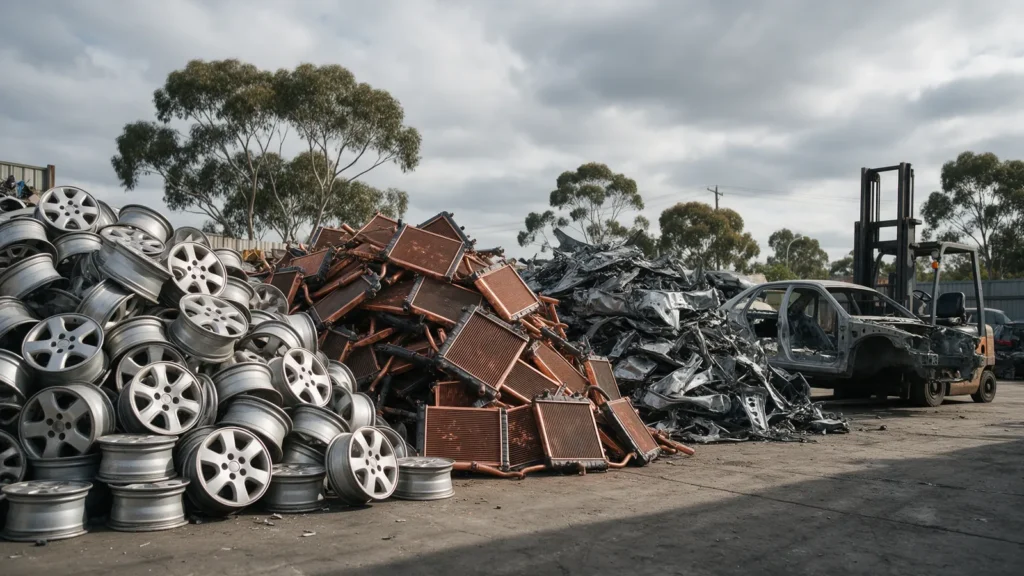
- Aluminium wheels. Usually graded on their own, and graded better with tyres, valve stems and balance weights removed.
- Radiators. Copper and brass radiators are worth more than aluminium and plastic ones.
- Copper wiring. The wiring loom is valuable, but insulated wire is graded on its likely copper yield, not its total weight.
- Electric motors. Starter motors and alternators contain copper windings inside a steel or aluminium case and form their own grade.
- Lead-acid batteries. Graded separately because they contain lead and acid. EPA Victoria notes they hold heavy metals that can leach into the environment if landfilled.
- Catalytic converters. Priced per unit rather than per kilogram. Their value comes from small amounts of platinum, palladium and rhodium in the internal coating, which vary by make and model.
Citation-ready summary: Car scrap is graded into ferrous metals such as body steel and cast iron, and higher-value non-ferrous metals such as aluminium, copper and lead, with catalytic converters priced per unit.
Weight, Contamination and Depollution: What Comes Off the Scale
Your scrap is paid on its net metal weight, not on how big the pile looks. Recyclers deduct anything that is not metal, either by removing it or by adjusting the grade.
Common deductions on car scrap include:
- Fluids. Engine oil, coolant, fuel, brake fluid and transmission fluid all have to be drained.
- Tyres. Rubber is not metal, and waste tyres must be recycled through proper channels.
- Glass, plastics and upholstery. Seats, dashboards, carpet and bumpers add weight without adding metal value.
- Refrigerant gas. Air conditioning systems need specialist recovery before the car is crushed.
- Batteries. Removed and handled separately because of the lead and acid.
This work is called depollution. EPA Victoria’s Auto Recyclers Guideline sets out how auto recyclers should drain, store and transport waste oils, coolants, batteries, tyres and refrigerants so they do not contaminate land and water. Depollution takes time and equipment, and that cost is part of why a whole car is not valued at the full steel price for its total weight.
How Scrap Is Weighed
Large loads and vehicles are usually weighed on a weighbridge, smaller loads on platform scales. The National Measurement Institute lists scrap metal among the goods that weighbridges used for trade can weigh, and requires those weighbridges to be pattern approved and verified by a servicing licensee. When a truck delivers scrap, the yard weighs it loaded, then empty. The difference is the weight of your scrap.
Citation-ready summary: Scrap is paid on net metal weight, after fluids, tyres, glass, plastics and batteries are removed or allowed for, using weighing equipment that must be verified for trade.
How a Dandenong Recycler Weighs and Pays for Your Scrap
Selling scrap in Victoria follows a set process because of state law. Here is what to expect when you deal with Wreckers Dandenong.
- Describe your scrap. Tell us what you have: a whole vehicle, a stripped shell, or loose scrap such as wheels, radiators or cable. Photos and an approximate weight help.
- Get a quote confirmed at quote time. We base the quote on that day’s market and the grades you have. We do not publish a fixed price list because it would be out of date within days.
- Show identification. Consumer Affairs Victoria requires scrap metal dealers to record the seller’s name, address and identification details, plus a description of the metal and its quantity or weight. For a motor vehicle, the dealer must also record its vehicle identifier.
- Weigh and grade. The scrap is weighed and graded, and the final figure is confirmed.
- Receive payment by EFT. Under Victoria’s scrap metal laws, dealers must not pay or receive cash for scrap metal. Payment is by electronic funds transfer or a cheque that is not transferable or payable to cash. This rule has applied since 30 May 2018, under amendments to the Second-Hand Dealers and Pawnbrokers Act 1989.
If a buyer offers cash for your scrap in Victoria, they are breaking the law. Our guide on whether wreckers pay cash for cars in Victoria explains the cash ban and EFT payment in more detail. If you are selling a whole vehicle, our list of documents needed to sell a car to wreckers in Victoria covers what to have ready on the day.
Citation-ready summary: In Victoria, scrap metal sellers must show identification, vehicles are recorded by their identifier, and payment must be by EFT or non-transferable cheque, never cash.
Whole Car, Stripped Shell or Loose Scrap: Which Way Is Worth More?
How you present your scrap changes how it is valued. Each option suits a different seller.
Selling the whole car. This is the simplest option if the car is complete. A wrecker values it on more than steel. Working engines, gearboxes, panels and lights can be resold as used parts, which often makes a complete car worth more than its scrap weight alone. Our article on how much wreckers pay for cars in Melbourne covers the factors that set a whole-vehicle offer.
Selling a stripped shell. If you have already sold the good parts, what remains is mostly body steel. It is graded as light steel, so value per kilogram is low. Shells with the engine, gearbox or catalytic converter removed are valued lower again, because those were the densest and most valuable metal in the car.
Selling loose scrap. Home mechanics and tradies often build up alloy wheels, old radiators, starter motors, cable and batteries. Kept separate, these items are graded individually and often achieve a better result than if mixed into a bulk pile.
If your car does not run, our car removal service collects broken-down, damaged and unregistered vehicles from homes, businesses and holding yards across Dandenong and nearby suburbs.
Citation-ready summary: A complete car is usually valued on its reusable parts as well as its metal, while a stripped shell is valued mainly as light-grade steel.
Practical Ways to Get a Fair Price for Your Scrap
You cannot control the LME, but you can control how your scrap is presented. These steps help each item get graded at its true value.
- Sort by metal. Use a magnet. Anything that sticks is ferrous. Keep copper, brass, aluminium and steel in separate piles or tubs.
- Strip non-metal parts where practical. Remove plastic shrouds from radiators, rubber hoses and wooden pallets.
- Do not burn cable to remove insulation. Burning damages the copper, produces toxic smoke and usually earns a lower grade than clean or insulated wire.
- Keep alloy wheels separate. Remove the tyres if you can, so the wheels are not graded with rubber attached.
- Leave catalytic converters on the car if you are selling it whole. They are assessed as part of the vehicle. If you hold a loose converter, have its make and model details ready.
- Drain nothing yourself unless you can dispose of it properly. Pouring oil or coolant onto the ground or into a drain harms waterways. Recyclers with proper depollution facilities handle fluids correctly.
- Bring identification every time. No identification means the dealer cannot complete the sale.
- Ask how the quote was graded. A clear quote names the grade and the weight basis, so you can compare like with like.
Frequently Asked Questions
How much is a scrap car worth per kilogram in Melbourne?
There is no fixed per-kilogram figure. Car body steel is the lowest-value grade, and the price moves with steel demand and the Australian dollar. A complete car is usually valued on its reusable parts and non-ferrous metals as well as its steel, so ask for a quote confirmed on the day.
Do scrap metal yards in Victoria pay cash?
No. Victorian law bans cash payments for scrap metal, including vehicles bought as scrap. Payment must be by electronic funds transfer or a non-transferable cheque.
What do I need to sell scrap metal in Victoria?
You need identification, because dealers must record your name, address and identification details. For a vehicle, the dealer also records its vehicle identifier, so bring proof of ownership and your registration details if you have them.
Is a catalytic converter worth more than the rest of the car?
It can be a significant part of a scrap car’s value, because it contains platinum, palladium and rhodium. Value varies widely by make and model, and converters are priced per unit, not per kilogram.
Getting a Confirmed Scrap Price in Dandenong
Scrap value comes down to three things you can check before you sell: what grade the metal is, how much of it is actually metal, and where world metal markets sit that week. Published price tables age fast, so treat them as background rather than an offer. A confirmed quote, an accurate weight and an EFT payment are what a lawful Victorian sale looks like.
To see which metals and vehicles we accept, visit our scrap metal recycling service, or request a scrap metal quote from Wreckers Dandenong on 04 9382 5076, Monday to Friday 7AM to 6PM and Saturday 8AM to 2PM.