No. When a wrecker buys your car as scrap in Victoria, they cannot legally hand you notes. Payment has to go into your bank account by electronic funds transfer, or come as a cheque that can’t be cashed by someone else. The phrase “cash for cars” survives as a slogan, but the money itself arrives electronically.
This matters for sellers in two ways. A wrecker who pays you correctly leaves a clean record of the sale, which protects you if questions come up later about the car. A buyer who pushes for a cash handover is either cutting corners or working outside the law, and that is a good reason to walk away.
The Short Answer: Scrap Car Payments Must Be Electronic
Victoria’s scrap metal laws say a dealer must not pay or receive cash for scrap metal. According to Consumer Affairs Victoria’s scrap metal laws page, the only permitted payment methods are:
- a cheque that is not transferable or payable to cash, or
- an electronic funds transfer (EFT), excluding e-currency.
E-currency means any internet-based means of exchange that doesn’t go through a bank or other authorised deposit-taking institution. Bitcoin is the example the regulator gives. So a wrecker can’t get around the rule by paying you in crypto either.
The key question is what counts as scrap metal. Consumer Affairs Victoria defines it as anything of commercial value that is made from or contains metal and is sold or obtained as scrap for recycling or reprocessing. That definition expressly includes a motor vehicle sold or obtained as scrap, whether or not it still runs. It also covers the body, engine or chassis of a vehicle sold as scrap.
In plain terms: a dead car in your driveway, a crashed hatchback, or a bare shell all fall inside the rule when a yard buys them for their metal. Running condition makes no difference.
When Did the Cash-for-Scrap Ban Start, and Why?
The ban took effect on 30 May 2018. The Victorian Government introduced it through amendments to the Second-Hand Dealers and Pawnbrokers Act 1989 and new regulations, as part of a push against organised crime.
The Premier of Victoria’s announcement of the cash for scrap ban explained the reasoning. Victoria Police and the Victorian Law Reform Commission had found the scrap metal and vehicle recycling industries were vulnerable to infiltration by organised crime. Stolen cars could be sold to a yard, crushed, and turned into untraceable cash within days.
The reforms did three things at once:
- Banned cash payments for scrap metal, including scrap vehicles.
- Banned trading in motor vehicles whose identification number had been removed or altered.
- Required anyone dealing in scrap metal to register as a second-hand dealer and keep detailed transaction records.
Police also gained power to enter business and storage premises without a warrant if they reasonably believe scrap metal dealing is happening there. An electronic payment trail links every scrap car to a named seller and a bank account, which is exactly what makes stolen vehicles harder to offload.
What the Law Covers, and the One Exception That Confuses People
Here is where most online explanations stop short. The cash ban applies to vehicles bought for recycling or reprocessing the metal. Consumer Affairs Victoria also states that second-hand vehicles bought for dismantling and selling the parts are not subject to the cash-for-scrap ban.
That carve-out explains why you may still hear of a yard paying cash for a car. If a business genuinely buys a vehicle to strip and resell its parts, the scrap ban does not apply to that purchase. The dealer still has to meet the other rules that apply to those vehicles, including registration and licensing.
The licensing side adds another layer. Consumer Affairs Victoria says a business usually needs a motor car trader’s licence under the Motor Car Traders Act 1986 to buy vehicles from the public with the intention of dismantling them. An auto wrecker can skip that licence only in narrow cases, such as buying only written-off, incomplete or damaged vehicles that can never return to the road.
For you as a seller, the practical point is simple. You usually can’t tell from the driveway whether a buyer plans to crush your car, part it out, or do a bit of both. Most cars that reach a wrecker end up as both: saleable parts come off first, and the shell goes to scrap metal recycling.
Wreckers Dandenong removes that guesswork. We pay by EFT for every vehicle we buy, so the payment method never depends on what happens to the car after it leaves your property. If you want to understand what drives the amount itself, our guide to how much wreckers pay for cars covers weight, parts demand and condition.
What Penalties Apply to a Wrecker That Pays Cash?
The penalties are set in penalty units, and their dollar value changes every financial year. Consumer Affairs Victoria lists the value of a penalty unit as $209.10 for 2026-27. Using that figure:
| Offence | Penalty units | Approximate amount (2026-27) |
|---|---|---|
| Buying or selling scrap metal for cash | 200 | $41,820 |
| Buying, disposing of or possessing an unidentified motor vehicle | 200 | $41,820 |
| Giving false or misleading information to police | 50 | $10,455 |
| Not keeping transaction records | 20 | $4,182 |
| On-the-spot fine: dealing in cash for scrap | 12 | $2,509.20 |
| On-the-spot fine: not registered as a second-hand dealer | 10 | $2,091 |
These figures are maximums for court-imposed offences, plus the on-the-spot fines police can issue under the Regulations. Section 19A of the Act aims the cash offence at second-hand dealers who buy or sell scrap metal, so the legal risk sits mainly with the business.
That doesn’t make a cash deal a good idea for the seller. A buyer willing to risk a fine of that size to avoid a paper trail is telling you something about how they run their business.
How EFT Payment Works on Pickup Day
An electronic payment adds very little to the process. Here is how a typical sale runs from first call to money in the bank:
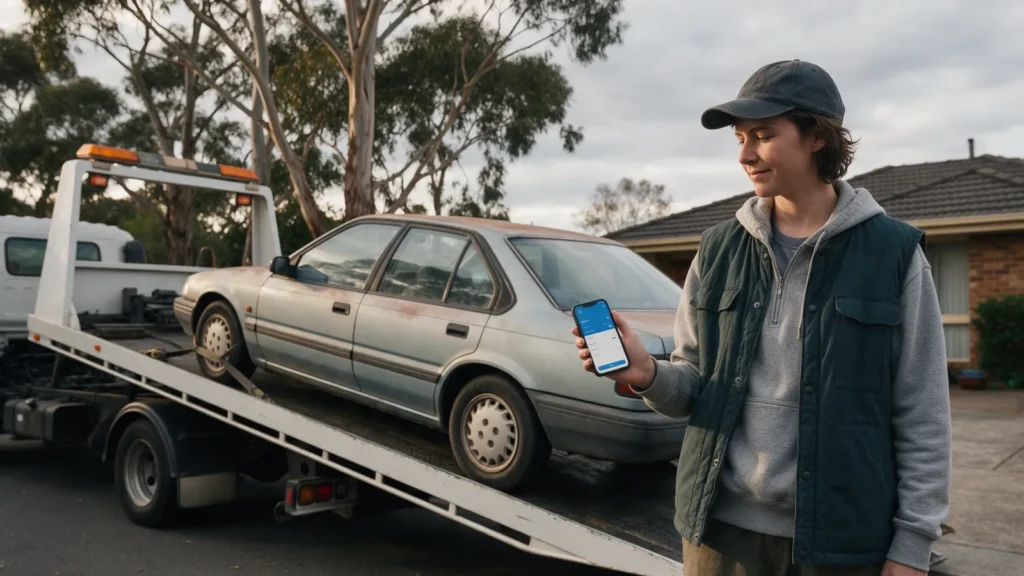
- Get a quote. Give the make, model, year, condition and location. The quote should state clearly how you will be paid.
- Book the collection. Arrange a time when you, or someone you have authorised, can be there with the keys.
- Show your ID. The wrecker records your name, address and identification details. This is a legal requirement, not a formality.
- The VIN is checked and recorded. The vehicle identifier is matched against the car and your paperwork.
- Sign the sale paperwork. You receive a receipt or bill of sale that names the buyer and the vehicle.
- Receive the transfer. The wrecker sends the agreed amount to your account by EFT, often using your BSB and account number or a PayID.
- Check your own banking app. Confirm the payment details and keep the remittance with your receipt.
Have your bank details ready before the tow truck arrives. A PayID linked to your mobile number or email makes this step quicker and means you don’t have to read out account numbers. Transfer speed depends on your bank and the payment method used. Some transfers land within moments, while others take until the next business day.
One caution applies to any sale. Never rely on a screenshot of a “completed” transfer on someone else’s phone. Check the money or the payment record in your own banking app.
Our post on the documents you need on pickup day lists the paperwork to have ready, including proof of ownership and what to do if the registration papers are lost.
Why a Wrecker Asks for Your ID and Records the VIN
Some sellers feel uneasy handing over a licence to a tow driver. The record-keeping rules explain why it happens. Under the Regulations, when a dealer buys scrap metal they must record:
- an accurate description of the item, including quantity or weight
- the vehicle identifier, if it is a motor vehicle
- the seller’s name and address
- the seller’s identification details
- the date and time the scrap was received
- a copy of the cheque or EFT
- the name of anyone acting on the dealer’s behalf.
The vehicle identifier is the Vehicle Identification Number (VIN) for vehicles made from 1 January 1989, or the chassis number for older vehicles.
The VIN check also protects you. A scrap metal dealer must not buy a scrap vehicle whose identifier has been removed, defaced, obliterated or altered. If the VIN is simply unreadable because of damage, age or wear, the dealer may collect the car, but they cannot pay for it. They also need written consent from a police officer before they possess, sell or dispose of it.
So if your old ute has a rusted-out VIN plate, mention it when you ask for a quote. It changes what the buyer can legally offer.
Red Flags: What It Means When a Buyer Offers Cash
A cash offer for a scrap car is a warning sign rather than a perk. Watch for these signs when comparing buyers:
- They insist on notes. A business buying your car as scrap cannot legally pay this way.
- They skip the ID check. A buyer who doesn’t record your details or the VIN isn’t keeping the records the law requires.
- There is no receipt. Without a receipt naming the buyer, you have weak evidence for your notice of disposal or a registration refund.
- The business details are vague. No business name, no fixed address and no landline are all reasons to keep looking.
- The price drops on arrival. A firm quote based on an honest description of the car should hold when the truck turns up.
A clean, documented sale with an electronic payment is the outcome you want. It costs the seller nothing extra and leaves a record that both sides can rely on.
After You’re Paid: Notice of Disposal and Registration
Getting paid does not finish the job. Two VicRoads steps protect you after the car leaves.
First, lodge a notice of disposal. VicRoads says the seller must submit a notice of disposal within 14 days, and you can do it online through myVicRoads. Until you do, tolls and fines linked to the vehicle can still find their way back to you.
Second, if the car is still registered, cancel the registration. VicRoads refunds unused registration time and accepts a wrecker’s receipt as evidence. A a processing fee plus 10% of the TAC charge comes out of the refund. You no longer need to return the number plates.
This is where the EFT record and the wrecker’s receipt earn their place. Together they show who bought the car, when, and for how much. When you book our car removal service, we provide the receipt at collection so you can complete both steps.
Frequently Asked Questions
Is it illegal to sell a car for cash in Victoria?
It depends on the type of sale. The cash ban covers scrap metal transactions, which include a car sold to a dealer as scrap. It does not, by itself, ban cash in an ordinary private sale of a car that is not being sold as scrap.
Can a wrecker pay me by cheque instead of EFT?
Yes. The law allows a cheque that is not transferable or payable to cash. EFT is more common because the money moves without a trip to the bank, and you don’t have to wait for a cheque to clear.
Do I need ID to sell my car to a wrecker?
Yes. When a dealer buys a scrap vehicle, they must record the seller’s name, address and identification details along with the VIN. Bring current photo ID, such as a driver licence, to the collection.
Why do some businesses still advertise “cash for cars”?
The phrase has become shorthand for selling an unwanted car for money. In Victoria, a car bought as scrap must be paid for by EFT or a non-transferable cheque. A narrow exception covers vehicles bought to dismantle for parts, but most reputable wreckers pay electronically regardless.
Getting Paid the Legal Way in South-East Melbourne
The money still comes to you. It just travels through the banking system, with your ID, the VIN and a receipt tying the sale together. That record helps when you lodge your notice of disposal, claim a registration refund, or need to show where the car went.
Wreckers Dandenong collects unwanted, damaged and unregistered vehicles across Dandenong, Noble Park, Springvale, Keysborough, Clayton, Mulgrave, Hallam, Berwick and surrounding suburbs, and pays every seller by EFT. See how our cash for cars service works, or request a quote for your car with EFT payment by calling 04 9382 5076, Monday to Friday 7AM to 6PM or Saturday 8AM to 2PM.